We are on the 9th of January 2024. The "Copernicus" analysis center has been analyzing data that has shown something extremely worrying. The global temperature in 2023 was extremely high, above any previously cataloged value.
Here we can see the increase in global temperature since 1850, which shows an extremely pronounced growth curve, without any reduction being expected. Which demonstrates a risk for all life on the planet.
We can also see that the average for 2023 is approaching 1.5 degrees Celsius, and above any other mark, which demonstrates a worrying and unprecedented change.
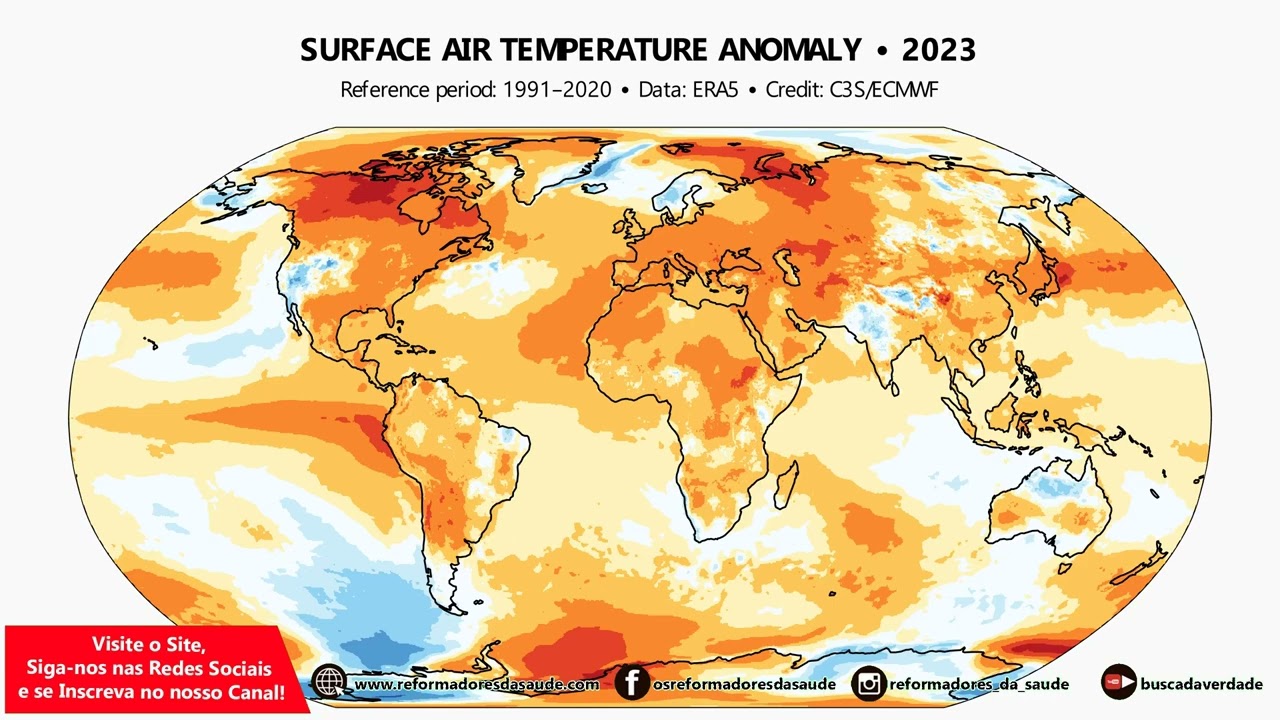
In this image we can see the abnormality of the air temperature on the planet Tierra. How can we understand this graph?Firstly, this graph is the comparative abnormality based on the average from 1991 to 2020, so if we use data from 2023 we have points with an abnormality variation of 6 degrees centigrade.
And these data determine that:
2023 is confirmed as the hottest year according to records of global temperature data dating back to 1850.
There is an average global temperature of 14.98 degrees Celsius, 0.17 degrees higher than the highest annual value in 2016.
It was 0.6 degrees warmer than the average from 1991-2020 and 1.48 degrees warmer than the preindustrial level from 1850 to 1900.
It is the first time recorded that every day of a year was more than 1 degree warmer than the preindustrial level from 1850 to 1900. About 50% of days were more than 1.5 degrees warmer than the preindustrial level from 1850 to 1900. 1900, and two days of November were, for the first time, more than 2 degrees warmer.
Each month, from June to December, of 2023 was hotter than the corresponding month of any previous year.
July and August 2023 were some of the hottest months on record. The northern summer (June to August) was also the hottest season ever recorded.
September 2023 was the month with a temperature deviation above the average from 1991 to 2020, greater than any month of the data set.
In the year 2023, the Antarctic sea will reach lower reaches. Daily and monthly extensions reached historic lows in February 2023.
A large number of extreme phenomena have been recorded throughout the world, including heat waves, floods, sequías and forest fires.
We can see that in November between the 17th and 18th there was a daily average higher than 2 degrees Celsius worldwide. Showing signs that global values greater than 2 degrees Celsius are becoming possible as a global average.
Marine heat waves were a common phenomenon in 2023 and affected regions such as the Mediterranean, the Gulf of Mexico and the Caribbean, the Indian Ocean and the North Pacific, and a large part of the North Atlantic.
The warming of the atmosphere and seas has generated an increase in temperature in several regions, and defines the persistence of high temperatures.
Winter greenhouse gas concentrations will reach the highest levels ever recorded in the atmosphere in 2023.
Carbon dioxide concentrations in 2023 were 2.4 parts per million, higher than in 2022, and methane concentrations increased by 11 parts per thousand million.
What we see is that countries that produce more greenhouse gases in the winter still continue to emit these gases, failing all the objectives sought in climate improvement meetings. What we are coming to is clearly the unbridled pursuit of climate destruction, by determining the capital objectives of the countries.