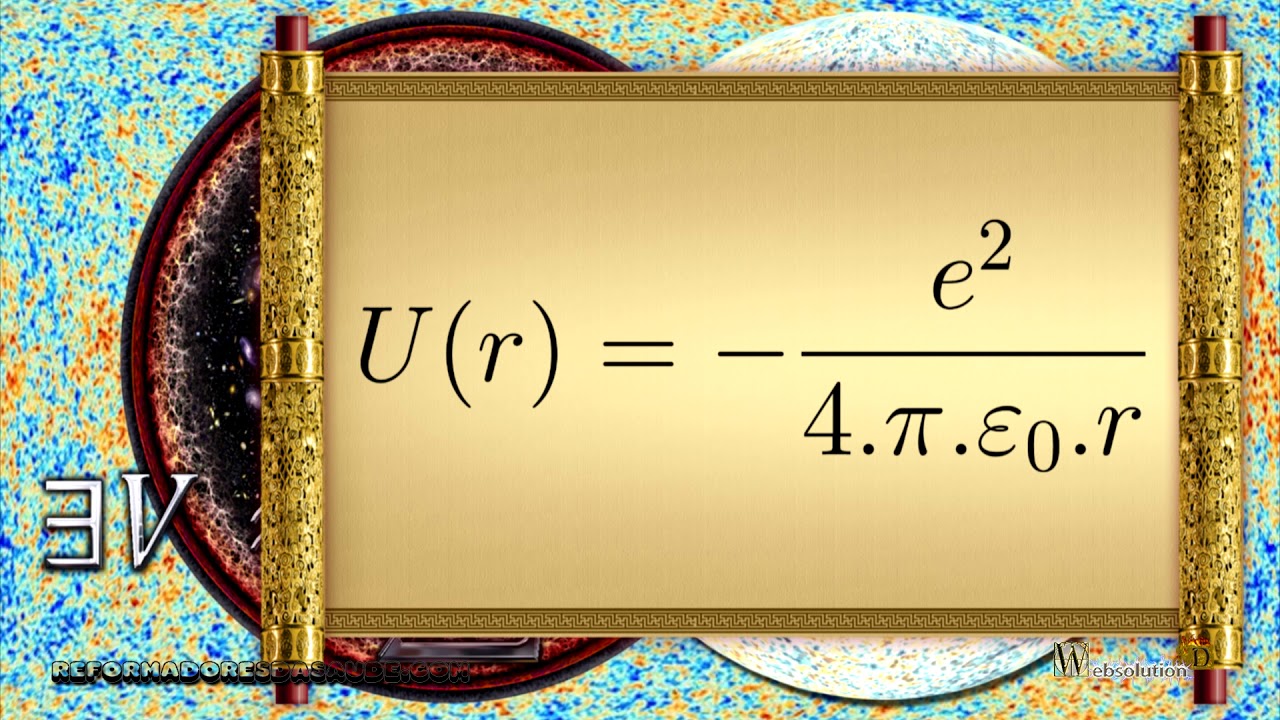
It is known that the minimum energy of one electron in the hydrogen atom equals -13.6 electron volts. By adopting a model of circular orbits, determine the value of the maximum approximation the electron can get from the nucleus.
Suppose electric potential energy has the same behavior with respect to distance as gravitational potential energy.
First we must understand that Mechanical Energy is the sum of potential energy with kinetics. But in this case we are talking about electrons, and the electron interaction and atomic nucleus. We are therefore ignoring that there is a gravitational effect on that electron. We can define which potential energy of the electron is according to the formula.
And we can see the formula of mechanical energy with the inclusion of the potential energy of the electron.
If you have a circular orbit, then there is a centripetal acceleration, which forms the normal force component, which will equal the force of attraction.
Thus the potential energy is half the kinetic energy. This is because if you have two opposing forces of the same intensity, they both generate the same energy, but the primary source of energy is the interaction between the nucleus and the electron. Hence the kinetic energy is half the potential.
Thus the minimum orbit is when the energy is minimal.
The minimum energy was given, -13.6 electron volt. In conversion an electron volt is 1.6 times 10 high to minus 19 Joule.
The mass of the electron is 9.1 times 10 high to minus 31 kilograms.
1 over 4 times Pi times epsilon 0 is 9 times 10 high to 9 Newton times square meter over Coulomb squared.
Thus converting the values ??and adding the constants.
We have the value of approximately 5.3 times 10 high to minus 11 meters, or 0.53 angstroms.
From this formula we can determine the distance in other layers of energy of interaction of the electron, in the atom of hydrogen. In the second layer the energy is -3.4 volts. So the core distance is 2.1 angstroms.
In the third layer we have -1.5 electrons volt, and the distance is now 4.8 angstroms. When the electron escapes the energy is 0, and the distance tends to the infinite, that is to say the electron escaped of the nucleus.